Sensitive skin is a large-area, flexible array of sensors with data processing capabilities, which can be used to cover the entire surface of a machine or even a part of a human body. Depending on the skin electronics, it endows its carrier with an ability to sense its surroundings via the skins proximity, touch, pressure, temperature, chemical/biological, or other sensors. Sensitive skin devices will make possible the use of unsupervised machines operating in unstructured, unpredictable surroundings among people, among many obstacles, outdoors on a crowded street, undersea, or on far away planets. Sensitive skin will make machines cautious‚ and thus friendly to their environment. This will allow us to build machine helpers for the disabled and elderly, bring sensing to human prosthetics, and widen the scale of machines use in service industry. With their ability to produce and process massive data flow, sensitive skin devices will make yet another advance in the information revolution. This paper surveys the state of the art and research issues that need to be resolved in order to make sensitive skin a reality.
INTRODUCTION
Sensitive skin represents a new paradigm in sensing and control. These devices will open doors to a whole class of novel enabling technologies, with a potentially very wide impact. Far-reaching applications not feasible today will be realized, ranging from medicine and biology to the machine industry and defense. They will allow us to fulfill our dream for machines sensitive to their surroundings and operating in unstructured environment.
Some applications that sensitive skin devices will make possible are yet hard to foresee. Flexible semiconductor films and flexible metal interconnects that will result from this work will allow us to develop new inexpensive consumer electronics products, new types of displays, printers, new ways to store and share information (like electronic paper and upgradeable‚ books and maps). New device concepts suitable for large area flexible semiconductor films will lead to new sensors that will find applications in space exploration and defense, specifically in mine detection and active camouflage.
SYSTEM CONCEPT
Sketch of interconnects between sensors, intelligence, and actuators
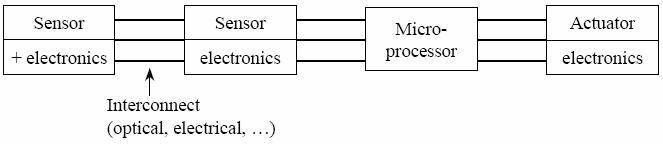
The system consists of a number of distributed sensor, actuator, and intelligence units, which are connected by some network of interconnects. The interconnects are necessary for providing power to the system as well as for communication. The sensors/actuators themselves may have intelligence associated with them, but there are other higher levels of intelligence to which they are connected. The interconnects shown in the system might be electrical (conventional wires) or optical (fibers). The communication via the individual units might in some cases be wireless (implying also fiber-less) for some structures. For delivering power, it was thought that the system probably would require physical interconnects (i.e. power delivered through fibers or wires), and that harnessing‚ energy from the environment, such as via solar or RF pick-ups, would not be practical for most applications (especially for wireless systems). Therefore in all cases there would have to be a physical interconnect between the individual sensor / actuator / intelligence blocks, and so a major part of this report addresses issues associated with this physical level of interconnection.
Potential applications of sensitive skin
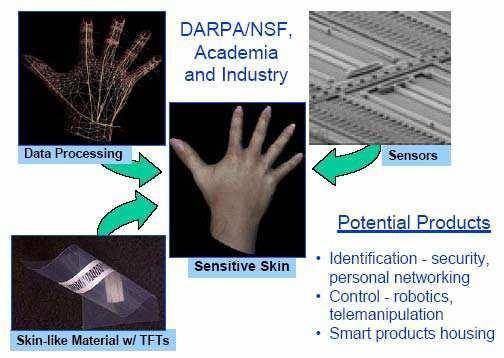
Four groups of research issues must be addressed in order to develop sensitive skin: Skin Materials, Sensing Devices, Signal and Data Processing, and Applications.
APPLICATIONS
1. Human Skin or Wearable Skin
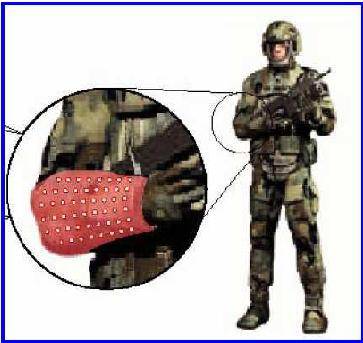
In the biomedical area, wearable sensitive skins can be used to restore sensory capability to people who have lost fine sensation in extremities (such as diabetics), or to people with spinal cord injuries. A relatively simple sensitive skin garment could be used to prevent pressure sores in bedridden or wheel chair bound people. A wearable sensitive skin would also be useful for overall physiological monitoring, such as frostbite detection. If the wearable sensitive skin can also include even a simple actuation capability, a very wide range of further biomedical applications becomes promising. For example simple distributed actuators could be used in applications such as thermoregulation, functional neuromuscular stimulation, smart compression for lymphatic system drainage, or controllable damping/stiffness for tremor reduction. Of course, the sensitive skin is not limited to the strain, vibration, and temperature senses of human skin. Proximity sensing would be a useful capability for the visually impaired. For military applications, sensors for laser, radar, chemicals, or Puncture would be quite valuable.
2. Sensitive Skins for Machines
If machines are to work nimbly in cluttered environments or with humans, they need sensitive skins with proximity and contact sensors. These sensors would provide information so the machines could protect both themselves and people they work with. For human-computer interaction, robot companions could respond appropriately to human touch. Moving vehicles could have an intelligent skin, which allows easier navigation in tight spaces, for example maneuvering automobiles on crowded streets.
3. Environmental Sensitive Skin
Even fixed structures as simple as floors and walls could have improved functionality using a low-cost sensitive skin. For example, a floor with distributed pressure sensors could be used for tracking, or a safety measure to warn of slippery spots or report falls. In civil engineering, skins for buildings and bridges can warn of fatigue or impending failure. For human computer interaction, surfaces could respond to gestures and infer intent, such as changing a lighting level.
4. Actuated Sensitive Skin
There is overlap between applications of passive sensitive skin and the whole area of active surfaces such as drag reduction in aero- and hydrodynamics. For example, active surface furniture such as chairs could increase comfort for people sitting for long periods of time. Active sensitive skin on walls could be used for sound and vibration canceling.
CONCLUSION
Sensitive skin is a large array of sensors embedded in a flexible, stretchable, and/or fold-able substrate that might cover the surface of a moving machine. By endowing these machines with ability to sense their surroundings, sensitive skin will make it possible to have unsupervised machinery in unstructured, unpredictable surroundings. Sensitive skin will make the machines cautious‚ and thus friendly to their environment. With these properties, sensitive skin will revolutionize important areas of service industry, make crucial contributions to human prosthetics, and augment human sensing when fashioned into clothing. Being transducers that produce and process information, sensitive skin devices will be generating and processing data flows in real time on a massive scale, which will lead to yet another leap in the information revolution.
Sensitive skin presents a new paradigm in sensing and control. It is an enabling technology with far reaching applications, from medicine and biology to industry and defense. The state of the art in the areas that are basic to development of the skin technology shows that highly efficient devices should be feasible, meaning by this high density of sensors on the skin, and hierarchical and highly distributed real time sensor data processing. All this non withstanding the fact that the existing prototypes are clumsy, have low resolution, accuracy and reliability, and are not yet ready for commercialization. Serious research issues elaborated in this paper have to be resolved before sensitive skins can become a ubiquitous presence in our society. We hope the readers will view this paper as our first effort to map out the new territory, and as an invitation to join in the exploration.