Radio frequency identification (RFID) is a technology that uses communication via radio waves to exchange data between a reader and an electronic tag attached to an object, for the purpose of identification and tracking.
RFID has gained more popularity because of its applications. The applications of RFID which includes human implants and parking control system are discussed in detail and also the overview of how RFID fits into the next generation is discussed. With more research, the flaws and limitations of this technology can be removed. This will make RFID technology very useful for diverse sectors like retail, transport and jewelry businesses.
INTRODUCTION
Radio Frequency Identification (RFID) is a proven technology that has been used in commercial applications since at least the 1970s, but has only recently been introduced to the consumer goods supply chain. Until recently, the expense of RFID, as well as lack of international standards, has limited its use to applications such as security badges and toll passes. As the cost of RFID systems decrease and standards are developed, companies are increasingly looking to use RFID technology to increase supply chain efficiencies and reduce supply chain costs. An RFID is highly reliable way to electronically control, detect & track variety of items using FM transmission methods. It is a method of automatic object identification using radio waves. A typical RFID system consists of RFID tags, interrogators or readers, and computers.
Radio Frequency Identification (RFID) is an emerging technology consisting of three key pieces: RFID tags (miniaturized chips); RFID readers; and a data collection, distribution, and management system that has the ability to identify or scan information with increased speed and accuracy. Compared to the bar code system, RFID promises long-term gains in supply chain management, transportation, defence and health care, to mention a few. RFID is increasingly used in commercial supply chain applications through pallet level tagging.
There are a variety of groups defining standards and regulating the use of RFID, including the International Organization for Standardization (ISO), the International Electrotechnical Commission (IEC), ASTM International, the DASH7 Alliance and EPCglobal.
Suggested Read:
COMPONENTS OF RFID
This system basically consists of following components.
- A transponder (RF tag)
- A transceiver (reader) with decoder
- An antenna.
Fig. 1 shows a model of basic RFID system.
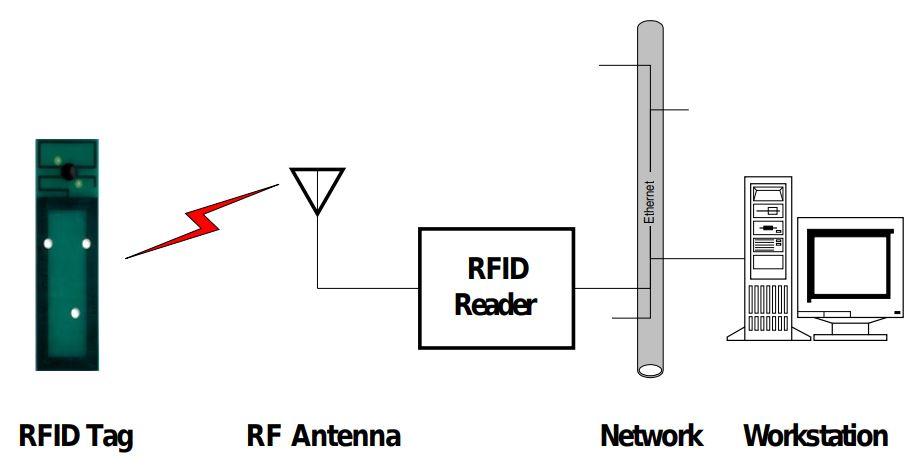
Active and passive RFID tags are the two types of RFID tags that are generally used. The active RFID tags transfer the information directly to the reader without the use of an external battery or source, whereas, the passive tags require external power for functioning.
A. RFID Tag
RFID systems. The software manages the interaction between the RFID reader and the RFID tags.
RFID tags shown in below picture are usually known as transponders and act as a transmitter as well as a receiver in the RFID system. The three basic components of the RFID tag are an antenna, a microchip (memory) and the encapsulating material. There are two types of RFID tags, as given below.
Read-Only Tag: In the read only tag, the microchip or memory is written only once, during the manufacturing process. The information, along with the serial number on the read only tag, can never be changed.
Read-Write Tag: In the read-write tag, only the serial number is written during manufacturing process. The remaining blocks can be re-written by the user.
Fixed RFID and Mobile RFID: Depending on mobility, RFIDs are classified into two different types: fixed RFID and mobile RFID. If the reader reads tags in a stationary position, it is called fixed RFID. On the other hand, if either the reader or the tag is mobile when the reader reads tags, it is called mobile RFID. Last, the RFID is classified into mobile RFID for the case that both the reader and the tag are mobile.
There are three types of RFID tags:
passive RFID tags, which have no power source and require an external electromagnetic field to initiate a signal transmission, active RFID tags, which contain a battery and can transmit signals once an external source (‘Interrogator’) has been successfully identified, and battery assisted passive (BAP) RFID tags, which require an external source to wake up but have significant higher forward link capability providing greater range.

B. RFID Reader
RFID reader is the device used to transmit to and receive information from the RFID tag. It is also referred to as an ‘interrogator’. It includes sensors that read the RFID tags in the vicinity.
C. Antennas
The antenna emits radio signals to activate the tag and read and write data to it. Antennas are the conduits between the tag and the transceiver, which controls the system’s data acquisition and communication. Antennas are available in a variety of shapes and sizes; they can be built into a door frame to receive tag data from persons or things passing through the door, or mounted on an interstate toll booth to monitor traffic passing by on a freeway. The electromagnetic field produced by an antenna can be constantly present when multiple tags are expected continually. If constant interrogation is not required, the field can be activated by a sensor device. Data is transferred without a line of sight to the tag. Note, however, that unfavorable conditions can cause transmission problems with certain technologies, such as metallic environments or liquids. Tags and readers/writers must have compatible frequencies. High-frequency (850 MHz to 950 MHz and 2.4 GHz to 2.5 GHz) systems, offering long read ranges (greater than 90 feet) and high reading speeds.
Supporting Infrastructure:
The supporting infrastructure, includes related software and hardware required for RFID systems. The software manages the interaction between the RFID reader and the RFID tags.
APPLICATIONS OF RFID TECHNOLOGY
- Payment by mobile phones
- Transportation payment
- Asset management and retail sales
- Product tracking
- Animal identification
- Hospital operating rooms
- Promotion tracking
- Libraries
- Passports
- Schools and universities
- Social retailing
- Race timing
- Human implants
- Parking control systems
RFID has many applications; for example, it is used in enterprise supply chain management to improve the efficiency of inventory tracking and management.
RFID in PARKING CONTROL SYSTEM
Parking lot operators, whether public or private, face a number of challenges such as:
- The inability to accurately and intelligently identify, collect and record the data of the vehicles that enter and leave the parking lot then processing this data to better analyze traffic patterns and facilitate client billings.
- Need to increase the security (and user integrity) of the parking lot.
- Adding human resources, especially in peak traffic times that burdens operating costs and reduces profitability.
- Line-ups created for parking payments, especially during peak traffic times that reduces the service levels to customers.
An intelligent parking control management system has launched that integrates RFID technology, automatic control technology and applications software. The RFID tag on the vehicle will be able to automate the in and out privileges of the subscriber and then transfer this data to the enterprise software for the above-mentioned benefits of traffic analysis that allow you to optimize the human resources needed for traffic flow in and out. For customer payment, the RFID tag can be read to debit a pre-pay system or charge the parking services against a credit card. All of this will facilitate customers entering and leaving and this improves service levels and increases capacity in the parking lot. These benefits will drive higher revenues.
This intelligent parking lot system is composed of RFID tags (for the vehicles), readers stationed around entry and exit points, applications software and then networked using TCP/IP network communication protocol. The system is flexible to allow a human interference, if necessary, to be able to accommodate unusual events such as when the non-tagged vehicles enter.Few of the parking control system devices are shown in Fig. 6.
The following picture shows the network enabled parking access control
ADVANTAGES OF RFID
RFID technology has a number of advantages.
- RFID tags are very simple to install/inject inside the body of animals, thus helping to keep a track on them. This is useful in animal husbandry and on poultry farms. The installed RFID tags give information about the age, vaccinations and health of the animals.
- RFID technology is better than bar codes as it cannot be easily replicated and therefore, it increases the security of the product.
- RFID Technology is commonly used for the access and attendance management. The smart cards are enclosed with RFID tags and unique IDs.
- RFID technology is also used in toll booths to implement FastTag where the vehicle is identified by the sticker put on the vehicle.
- RFID is also being used in the healthcare domain for the tracking purpose in mobile medical equipment, improve patient workflow, monitor environmental conditions, and protect patients, staff and visitors from infection or other hazards.
- Supply chain management forms the major part of retail business and RFID systems play a key role by managing updates of stocks, transportation and logistics of the product.
- Barcode scanners have repeatedly failed in providing security to gems and jeweleries in shops. But nowadays, RFID tags are placed inside jewelry items and an alarm is installed at the exit doors.
- The RFID tags can store data up to 2 KB whereas, the bar code has the ability to read just 10-12 digits. The barcode system on books in library is also being replaced with RFIDs to automate the book issue and tracking mechanism.
- The waste management industry has also started using RFID tecnology. RFID tags are installed on waste collection carts, linking carts to the owner’s account for easy billing and service verification
DISADVANTAGES OF RFID
The RFID technology, though very beneficial, is expensive to install. Small and medium scale enterprises find it costly to use it in their firms and offices.
- It is difficult for an RFID reader to read the information in case of RFID tags installed in liquids and metal products. The problem is that the liquid and metal surfaces tend to reflect the radio waves, which makes the tags unreadable. The tags have to be placed in various alignments and angles for taking proper reading. This is a tedious task when the work involves big firms.
- Interference has been observed if devices such as forklifts and walkie-talkies are in the vicinity of the distribution centers. The presence of mobile phone towers has been found to interfere with RFID radio waves. Wal-Mart, the retail sector giant, has installed billions of RFID tags in their products throughout the world and they have encountered such problems.
- The USA and Europe, for instance, have different range of frequencies that allow RFID tags to function. This makes it mandatory for international shipping companies and other organizations to be aware of the working pattern of other nations also, which can be very time-consuming.
- RFID technology has been referred to as invasive technology. Consumers are apprehensive about their privacy when they purchase products with RFID tags. Once the radio chips are installed in the product, the customer can be tracked and his personal information can be collected by the RFID reader. However, many stores have a facility that deactivates the RFID tags after the product has been purchased.
CONCLUSION
RFID, because it is a cross-cutting and enabling technology, adds to the important role ICT (Information and Communications Technology) plays to promote innovation, economic growth, and global commerce. Looking toward the future, as the information infrastructures associated with RFID are increasingly accessed across IP networks, the OECD (Organisation for Economic Co-operation and Development) is well positioned to discuss with stakeholders how best to create a positive environment for growth, and promote best practices for the implementation and use of RFID.
RFID technology can be the next tool for success and management of various businesses. With more research, the flaws and limitations of this technology can be impreoved. This will make RFID technology very useful for diverse sectors like retail, transport and jewelry businesses.