Mobile ad hoc network (MANET) is an autonomous system of mobile nodes connected by wireless links. Each node operates not only as an end system, but also as a router to forward packets. The nodes are free to move about and organize themselves into a network. These nodes change position frequently. To accommodate the changing topology special routing algorithms are needed. For relatively small networks flat routing protocols may be sufficient. However, in larger networks either hierarchical or geographic routing protocols are needed. There is no single protocol that fits all networks perfectly. The protocols have to be chosen according to network characteristics, such as density, size and the mobility of the nodes. MANET does not require any fixed infrastructure, such as a base station, therefore, it is an attractive option for connecting devices quickly and spontaneously. Mobile ad hoc networks can be used alone (for example in the military) or as a hybrid together with the Internet or other networks. Different MANET applications have different needs, and hence the various Mobile Ad Hoc Network routing protocols may be suitable in different areas. The size of the network and the frequency of the change in topology are factors that affect the choice of the protocols. There is no best protocol for all applications. There is still ongoing research on mobile ad hoc networks and the research may lead to even better protocols and will probably face new challenges.
Introduction
Information technology is rapidly changing from regular desktop computing, where isolated workstations communicate through shared servers in a fixed network, to an environment where a large number of different platforms communicate over multiple network platforms. In this environment the devices adapt and reconfigure themselves individually and collectively, to support the requirements of mobile workers and work teams. In the next generation of wireless communication systems, there will be a need for the rapid deployment of independent mobile users. Mobile Ad Hoc Networks (MANETs) provide communication between all nodes in the network topology without the presence of a centralized authority; instead all nodes can function as routers. This gives the MANETs two of its most desirable characteristics; adaptable and quick to deploy. MANET research is still in progress, and currently MANETs are not widely used. Suggested areas of use will include establishing efficient communication networks for mobile workers in desolate regions or in disaster areas where existing networks have been destroyed or do not exist. To communicate in an efficient way proper routing protocols are needed.
Mobile Ad Hoc Networks (MANETs) consist of nodes that change position frequently. To accommodate the changing topology special routing algorithms are needed. For relatively small networks flat routing protocols may be sufficient. However, in larger networks either hierarchical or geographic routing protocols are needed. There is no single protocol that fits all networks perfectly. The protocols have to be chosen according to network characteristics, such as density, size and the mobility of the nodes. Mobile ad hoc networking is one of the more innovative and challenging areas of wireless networking, one which promises to become increasingly present in our lives. Consisting of devices that are autonomously self- organizing in networks, ad hoc networks offer a large degree of freedom at a lower cost than other networking solutions.
A MANET is an autonomous collection of mobile users that communicate over relatively slow‚ wireless links. Since the nodes are mobile, the network topology may change rapidly and unpredictably over time. The network is decentralized, where all network activity, including discovering the topology and delivering messages must be executed by the nodes themselves. Hence routing functionality will have to be incorporated into the mobile nodes. since the nodes communicate over wireless links, they have to contend with the effects of radio communication, such as noise, fading, and interference. In addition, the links typically have less bandwidth than a wired network. Each node in a wireless ad hoc network functions as both a host and a router, and the control of the network is distributed among the nodes. The network topology is in general dynamic, because the connectivity among the nodes may vary with time due to node departures, new node arrivals, and the possibility of having mobile nodes.
An ad hoc wireless network should be able to handle the possibility of having mobile nodes, which will most likely increase the rate at which the network topology changes. Accordingly the network has to be able to adapt quickly to changes in the network topology. This implies the use of efficient handover protocols and auto configuration of arriving nodes.
Mobile Ad Hoc Network Routing Protocols

Generally routing protocols in MANETs are either based on the link-state (LS) routing algorithm or on the distance-vector (DV) routing-algorithm. Common for both of these algorithms is that they try to find the shortest path from the source node to the destination node. The main difference is that in LS based routing a global network topology is maintained in every node of the network. In DV based routing the nodes only maintain information of and exchange information with their adjacency nodes. Keeping track of many other nodes in a MANET may produce overhead, especially when the network is large. Therefore one of the most important issues in MANET design is to come up with schemes that will contribute to reduce routing overheads.
Mobile Ad Hoc Network routing protocols fall into two general categories:
1. Proactive routing protocols
2. Reactive routing protocols
Different Routing Protocols
- Flat Routing Protocols
Pro-Active/Table Driven routing Protocols
Reactive/On Demand Routing Protocols - Hybrid Routing Protocols
- Hierarchical Routing Protocols
- Geographical Routing Protocols
Flat routing protocols are divided into two classes;
proactive routing (table driven) protocols and reactive (on-demand) routing protocols.
Common for both protocol classes is that all nodes participating in routing play an equal role. They have further been classified after their design principles; proactive routing is mostly based on LS (link-state) while on-demand routing is based on DV (distance- vector).
Pro-Active/Table Driven routing Protocols
Proactive MANET protocols are table-driven and will actively determine the layout of the network. Through a regular exchange of network topology packets between the nodes of the network, a complete picture of the network is maintained at every single node. There is hence minimal delay in determining the route to be taken. This is especially important for time-critical traffic (Scientific Research Corporation, 2004). However, a drawback to a proactive MANET of protocol is that the life span of a link is significantly short. This phenomenon is brought about by the increased mobility of the nodes, which will render the routing information in the table invalid quickly. When the routing information becomes invalid quickly, there are many short-lived routes that are being determined and not used before they turn void. Hence, another drawback resulting from the increased mobility is the amount of traffic overhead generated when evaluating these unnecessary routes. This is especially aggravated when the network size increases. The fraction of the total control traffic that consists of actual practical data is further decreased.
Examples of Proactive MANET Protocols include:
1. Optimized Link State Routing, or OLSR
2. Topology Broadcast based on Reverse Path Forwarding, or TBRPF
3. Fish-eye State Routing, or FSR
4. Destination-Sequenced Distance Vector, or DSDV
5. Landmark Routing Protocol, or LANMAR
6. Clusterhead Gateway Switch Routing Protocol, or CGSR
Reactive/On Demand Routing Protocols
On-demand routing is a popular routing category for wireless ad hoc routing. It is a relatively new routing philosophy that provides a scalable solution to relatively large network topologies. The design follows the idea that each node tries to reduce routing overhead by only sending routing packets when communication is requested. Common for most on- demand routing protocols are the route discovery phase where packets are flooded into the network in search of an optimal path to the destination node in the network.
There are numerous on-demand routing protocols, but only two of them are more significant. These are Ad Hoc On-Demand Distance Vector Routing (AODV) and Dynamic Source Routing (DSR). These two have been chosen because both have been extensively evaluated in the MANET literature and are being considered by the Internet Engineering Task Force (IETF) MANET Working Group as the leading candidates for standardization. Thus, reactive MANET protocols are most suited for networks with high node mobility or where the node transmits data infrequently.
Examples of Reactive MANET Protocols include:
1. Ad Hoc On-Demand Distance Vector, or AODV
2. Dynamic Source Routing, or DSR.
3. Temporally Ordered Routing Algorithm, or TORA
Hybrid Routing Protocols
Since proactive and reactive routing protocols each work best in oppositely different scenarios, there is good reason to develop hybrid routing protocols, which use a mix of both proactive and reactive routing protocols. These hybrid protocols can be used to find a balance between the proactive and reactive protocols.
The basic idea behind hybrid routing protocols is to use proactive routing mechanisms in some areas of the network at certain times and reactive routing for the rest of the network. The proactive operations are restricted to a small domain in order to reduce the control overheads and delays. The reactive routing protocols are used for locating nodes outside this domain, as this is more bandwidth-efficient in a constantly changing network.
Examples of Hybrid Routing Protocols include:
1. Cornell’s Zone Routing Protocol (ZRP)
2. Scientific Research Corporation’s Wireless Ad hoc Routing Protocol (WARP) – based on ZRP with additional enhancements for Quality of Service, or QoS support (Mobile Route TM)
Hierarchical Routing Protocols
As the size of the wireless network increases, the flat routing protocols may produce too much overhead for the MANET. In this case a hierarchical solution may be preferable. CGSR, HSR, ZRP and LANMAR are four hierarchical routing protocols that have different solutions to the organization of the routing of nodes in a MANET.
Examples of Hierarchical Routing Protocols include:
1. CGSR (Cluster head-Gateway Switch Routing)
2. HSR (Hierarchical State Routing)
3. ZRP (Zone Routing Protocol)
4. LANMAR (Landmark Ad Hoc Routing Protocol)
Geographical Routing Protocols
There are two approaches to geographic mobile adhoc networks:
1. Actual geographic coordinates (as obtained through GPS – the Global Positioning System)
2. Reference points in some fixed coordinate system
An advantage of geographic routing protocols is that they prevent network-wide searches for destinations. Control and data packets can be sent in the general direction of the destination if the recent geographical coordinates are known. This reduces control overhead in the network. The routing update must be done faster than the network mobility rate to make the location-based routing effective. This is because the nodes locations may change quickly in a MANET.
Examples of Geographical Routing Protocols include:
1. GeoCast (Geographic Addressing and Routing)
2. DREAM (Distance Routing Effect Algorithm for Mobility)
3. GPSR (Greedy Perimeter Stateless Routing)
MANETs Application Areas
Significant examples of Mobile Ad Hoc Networks include establishing survivable, efficient and dynamic communication for emergency/rescue operations, disaster relief efforts, and military networks. Such network scenarios cannot rely on centralized and organized connectivity, and can be conceived as applications of Mobile Ad Hoc Networks.
However, MANETs are not solely intended for disconnected autonomous operations or scaled scenarios (i.e. hundreds or even thousands of cooperation wireless nodes in a region). They may be used as hybrid infrastructure extensions and in fixed infrastructure operations. A hybrid infrastructure extension is a dynamic enhancement to a home or campus wireless networking environment. It provides extended service and allows low-cost, low complexity dynamic adjustments to provide coverage regions and range extensions away from the more fixed infrastructure backbone networks.
There are also other network application areas; cooperatives and sensors. In cooperatives a community of interest (i.e. a small town government, infrastructure-lacking world region, group of interested individuals/club) own and operate a network infrastructure together. These networks could deploy MANET technology to support a self- organizing, adaptive infrastructure. This will be desirable in disadvantaged rural regions and developing countries with lack of resources or an environment not suited for significant fixed- infrastructure developments and services.
MANET technology can be used here to help building and operating inexpensive network infrastructure services. Sensor networks may be more scaled and capable using MANET technology. Commercial, environmental and military applications are all interested in this. MANET technology can support broad applications of self-organizing and distributed sensor networks.
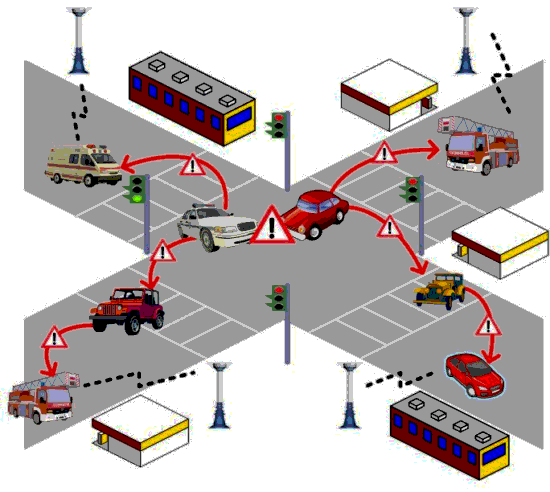
Figure 2: VANET (Vehicular Ad-hoc Networks)
Vehicular Ad Hoc Network (VANET) is a subset of mobile ad-hoc network, which supports data communications among nearby vehicles and between vehicles and nearby fixed infrastructure, and generally represented as roadside entities. Depending on the range of data communications, nodes in VANET communicate among themselves in type of short-range (vehicle-to-vehicle) or medium-range (vehicle-to-roadside) communications.
Conclusion
All the Mobile ad hoc network routing protocols mentioned in this post are either on-demand or proactive. There is a trade-off between sending updates often or just when needed. Sending updates may produce overhead in mobile ad hoc networks because the nodes are moving frequently. When the size of the network is small a flat routing protocol will be sufficient. Then each node keeps track of the other nodes in its routing table. How the nodes discover other nodes and how they send requests for a destination, differs between the routing protocols.
Flat routing protocols are available immediately and they support quality of service in MANETs. However, when the size of a MANET increases the flat routing protocols may not be sufficient. Then either a hierarchical or a geographic routing protocol would be a better solution. The hierarchical routing protocols organize the nodes in hierarchies and have smaller routing tables because the nodes only need to keep track of their levels in the hierarchy. Also, in search for destinations the amount of flooding packets is reduced. However, the hierarchical routing protocols may also produce overhead to maintain the hierarchical structure. The geographic routing protocols use the knowledge of node locations to organize the structure of a MANET. They may produce overhead when exchanging coordinates, but all in all they can become more scalable and effective than the flat routing protocols.
MANETs can be used alone (for example in the military) or as a hybrid together with the Internet or other networks. Different MANET applications have different needs, and hence the various MANET routing protocols may be suitable in different areas. The size of the network and the frequency of the change in topology are factors that affect the choice of the protocols. There is no best protocol for all applications. For flat, hierarchical and geographic routing protocols, scalability is a big challenge. There is still ongoing research on mobile ad hoc networks and the research may lead to even better protocols and will probably face new challenges. The current goal is to find an optimal balance between scalable routing and media access control, security, and service management.
nice
Thank you Ligisha.
Comments are closed.